
Do you know how often you use your hands every day? Countless times. And the uses vary from irrelevant to vital actions throughout the day. What if you couldn’t use your hand anymore the way you always did in your life? There are conditions such as Parkinson’s disease and essential tremors that can make things difficult for those who are affected by it. A company called GyroGear made it their objective to help such people with technology and developed the GyroGlove, which is a wearable device to stabilize gestures and hand movements.
How do Parkinson’s disease and essential tremors affect people?
Parkinson’s disease and essential tremors have a significant impact on the daily lives of those affected by them. These conditions can severely affect a person’s ability to perform simple tasks that most of us take for granted, such as pouring a glass of water or using a knife and fork to eat. The tremors and uncontrollable movements caused by these conditions make it extremely challenging for individuals to maintain a steady hand, resulting in spills, difficulty gripping utensils, and even struggle with basic self-care activities. In addition to the practical difficulties, Parkinson’s disease and essential tremors can hinder people from enjoying hobbies and activities requiring precise hand movements.

Activities like painting, playing musical instruments, or even typing on a keyboard can become virtually impossible. This loss of independence and the inability to engage in activities that bring joy and fulfillment can profoundly impact a person’s mental well-being. Furthermore, the effects of these conditions extend beyond personal life and impact professional careers and family life as well. The inability to perform tasks requiring manual dexterity can limit job opportunities and career advancements, leading to financial strain and frustration.

Moreover, the challenges faced in daily life can create a challenge for family members who may need to assist with everyday tasks that were once taken for granted. It is important to note that there is currently no cure for essential tremor and Parkinson’s disease. These degenerative neurological conditions affect millions of people worldwide, and the available treatments mainly focus on managing symptoms rather than providing a complete solution.
How does GyroGlove work?
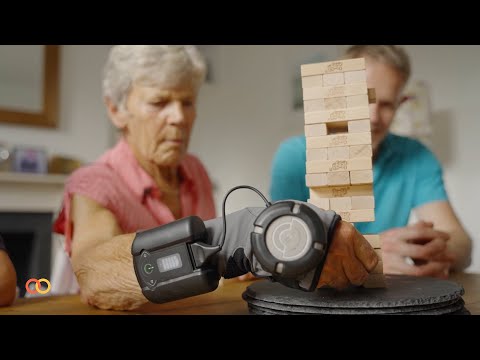
The GyroGlove, or anti-tremor gyroscopic orthotic glove in long, from GyroGear, was developed to stabilize hand movement of people who experience Parkinson’s disease and essential tremors. Upon activation, the device initiates the rotation of a battery-powered gyroscope, which promptly counteracts the wearer’s movements to restore balance. This instantaneous and proportional resistance effectively mitigates tremors in the hand, enabling steady control. The system employs a gyroscope that can be dynamically adjusted to accommodate individual needs, so it’s unlike a robotic rehabilitation system, which would be worn only temporarily.

Housed within a lightweight casing, the gyroscope is securely affixed to the back of the hand via a harness integrated into the glove’s material, ensuring optimal functionality and convenience. We looked at the technical aspects and details of the GyroGlove and discovered that the device boasts impressive capabilities, rotating four times faster than jet turbine blades. It endures an astonishing 11 billion revolutions throughout its targeted three-year lifespan. Additionally, it provides a level of precision that surpasses a computer drive by a factor of 100.
Is it worth that?
What a challenging question, indeed. The price for one GyroGlove is 4899 USD on the current discount, and the regular price would be 5899 USD. So there is a massive bill to take care of for sure. Beyond that, we are talking about a device with a three-year projected lifetime, so it’s more than likely that you would need to re-purchase them a few times. On the other hand, it’s a drug-free solution, and perhaps a health insurance company would, at some point, decide it would be better to pay for such a device rather than pay for drug treatments.

Or an insurance company that would pay you an invalidity allowance would decide it’s cheaper for them to get you such a glove and have you be a part of the workforce still instead of paying the allowances or pension costs. Even if we consider in the math that a device would only last about three years, the monthly cost of even the undiscounted 5899 USD would be only 163.86 USD, and suddenly, this figure seems so much more affordable to both consumers and insurance companies. Could a cost of under 200 USD per month help someone live a better life or continue their jobs?

That sounds like a good investment. Even if we are talking about people who are already retired, it just takes that amount of money to regain more control in their lives, and it’s undoubtedly a huge improvement for their quality of life. Beyond that, there is hope that insurance companies might cover the cost for such a device and their replacements over time, even if they might be slow to trial and adopt new tech. To me, it would be a no-brainer.
GyroGear’s GyroGlove received the CES 2024 innovation awards honoree badges in the categories “Accessibility and Aging Tech,” “Wearable Technologies,” and “Digital Health.” If you are attending the CES 2024, you can find them at Eureka Park, Tech West, Venetian Expo, Level 1, Hall G, Booth #61613.
YouTube: The GyroGlove by GyroGear – Consumer Electronics Show (CES) 2024 Innovation Awards
By clicking play, you agree to YouTube's Terms of Service and Privacy Policy. Data may be shared with YouTube/Google.
Photo credit: The images shown are owned by GyroGear and were used with permission.
Source: Press information
