
Researchers at École Polytechnique Fédérale de Lausanne (EPFL) have designed an innovative crewless aerial vehicle that mimics the movement of birds, setting a new standard for drone versatility. Named RAVEN, short for Robotic Avian-inspired Vehicle for multiple ENvironments, this drone combines the ability to walk, hop, and leap into flight, granting it access to areas previously challenging for conventional drones. This breakthrough could transform how we use drones across multiple industries with potential applications in disaster relief, delivery services, and infrastructure inspection.
A flight inspired by nature
The inspiration behind RAVEN came from observing how birds like crows and ravens transition seamlessly between walking, hopping, and flying. Won Dong Shin, a PhD student at the Laboratory of Intelligent Systems (LIS) in EPFL’s School of Engineering, played a key role in translating these natural movements into engineering reality.

“Birds were the inspiration for airplanes in the first place, and the Wright brothers made this dream come true, but even today’s planes are still quite far from what birds are capable of,” Shin explained. “Birds can transition from walking to running to the air and back again, without the aid of a runway or launcher. Engineering platforms for these kinds of movements are still missing in robotics.”
Related article: What Is Biomimicry?
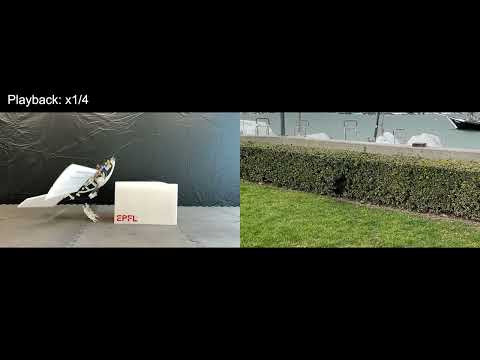
RAVEN’s unique design uses lightweight but functional robotic legs with flexible feet and joints. These innovations allow the drone to walk over uneven ground, hop across gaps in terrain, and jump up to heights of 26 centimeters before taking flight, all while maintaining stability and energy efficiency.
Addressing key challenges
Traditional drones have long been constrained by their reliance on runways or large open spaces for takeoff, limiting their use in cluttered or inaccessible environments. RAVEN solves this problem with its ability to execute a vertical “jumping takeoff,” which combines kinetic speed and potential height for an efficient transition into flight.
Worth reading: These Self-Assembling Robots Could Be the Future of Assisted Living
“Translating avian legs and feet into a lightweight robotic system presented us with design, integration, and control problems that birds have solved elegantly over the course of evolution,” said Professor Dario Floreano, head of LIS. “This led us to not only come up with the most multimodal winged drone to date but also to shed light on the energetic efficiency of jumping for takeoff in both birds and drones.”

These capabilities also make RAVEN ideal for navigating rugged terrain, confined urban spaces, or remote areas. By eliminating the need for smooth surfaces or human intervention during launch, the drone can operate effectively in settings that have traditionally posed challenges to UAVs.
Applications and beneficiaries
RAVEN’s potential applications are incredibly diverse. Its innovative and multifunctional design offers opportunities to transform multiple industries. Its capabilities make it a valuable asset across various fields, paving the way for new advancements and solutions.
- Disaster relief: During emergencies, first responders often have to access difficult terrain, such as collapsed buildings or mountainous areas. RAVEN’s ability to traverse landscapes and deliver essentials like medical supplies or communication equipment could save lives.
- Delivery services: The rise of ecommerce and logistical demands in urban and rural areas has fueled interest in delivery using drones. RAVEN’s capability to maneuver around tight spaces or difficult landscapes makes it a promising tool for “last-mile” deliveries.
- Infrastructure inspection: Industries like construction and energy often require routine inspections in hazardous or remote locations. RAVEN’s design allows it to explore hard-to-reach areas, reducing the risks to human inspectors while improving efficiency.
- Scientific research and exploration: From tracking wildlife to surveying rough terrain for ecological studies, RAVEN could support researchers conducting fieldwork in environments inaccessible to humans or traditional drones.

Looking ahead
The team is refining RAVEN’s design, particularly its landing capabilities, to expand its usability further. “Avian wings are the equivalent of front legs in terrestrial quadrupeds, but little is known about the coordination of legs and wings in birds—not to mention drones,” Floreano remarked. These results represent a first step towards a better understanding of multi-modal flying animals’ design and control principles and their translation into agile and energetically efficient drones.
Before you go: Raptors Now Protect Your Privacy from Rogue Drones
RAVEN highlights how biomimicry, or taking inspiration from nature, can lead to engineering breakthroughs with real-world impact. Whether delivering medicine to remote areas or inspecting infrastructure after a disaster, this bird-inspired drone is primed to make a significant difference in robotics and beyond.
YouTube: RAVEN (Robotic Avian-inspired Vehicle for multiple ENvironments)
By clicking play, you agree to YouTube's Terms of Service and Privacy Policy. Data may be shared with YouTube/Google.
Photo credit: All photos have been taken by Alain Herzog via the EPFL. See the source link below for more details and data.
Source: EPFL press release
