
Once you drop a standard sofa into a living room, it quietly takes over the floor plan. Its footprint sets a hard boundary, and everything else – the rug, the coffee table, the side chairs, even where you can run a lamp cord – has to negotiate around it. A sectional sofa flips that script. Because it is built from independent modules that can be joined, split apart, or rotated, the furniture adapts to how you actually use the room instead of locking you into Day 1’s layout.
That kind of “spatial modularity” is one of the most underrated advantages of going sectional over a fixed three- or four-seater. It is not just about getting bored and shuffling furniture around on a Sunday afternoon. Life changes the requirements of a room faster than most people expect: a new baby, a shift to working from home, a move into a narrower apartment, or simply hosting more people. A modular frame absorbs those changes without forcing you to eat the cost and hassle of replacing the biggest piece of furniture you own.
What Architectural Thinking Says About Modular Seating
Architects and interior designers treat the sofa differently than almost any other object in a home. Because it is usually the largest and heaviest visual mass in the room, a traditional sofa acts like a fixed anchor. Once it lands in a corner or against a main wall, it ends up stiffening a space and restricting movement, rarely moving again even years later when the household’s habits look completely different.
Modular seating solves that bottleneck directly. By breaking one rigid monolith into smaller, interchangeable units, a single sofa can support several distinct floor plans over its lifespan. Moving from a static anchor to a reconfigurable system is one of the smartest practical shifts in domestic furniture design over the last twenty years, and it is the main reason sectionals have become the default pick for open-plan and multifunctional living spaces.
The trade-off is simple: a sectional asks for a bit more upfront planning than a plug-and-play couch, because you have to think about how the modules fit together. In return, you get far better long-term utility. The same hardware can scale into a new room, a different household size, or a new daily routine without starting from scratch.
Sectional Flexibility and What It Asks of the Cover
Layout flexibility has a quieter twin that people often overlook: the fabric. If a sofa is going to shift from an L-shape against two walls to separate seating around a coffee table, or stretch into a single straight run in a future apartment, the upholstery has to hold up visually in every one of those setups.
That immediately works against loud directional prints or heavy stripes. A pattern that lines up cleanly in one arrangement can look completely fractured the moment you swap two modules around. A solid, natural fabric in a grounded tone sidesteps that headache completely. Because its look does not rely on a specific sequence of pieces, every new layout reads as deliberate rather than improvised.
For households with IKEA sectionals that want the same adaptability in the fabric as in the frame, slipcovers made for IKEA sectionals in natural linen and cotton are cut to the exact dimensions of each individual module. Because each unit is dressed separately, you can unclip and rearrange the sections into any layout without losing fit or visual continuity. The cover works with the system instead of fighting it.
Configurations Worth Considering Before You Commit
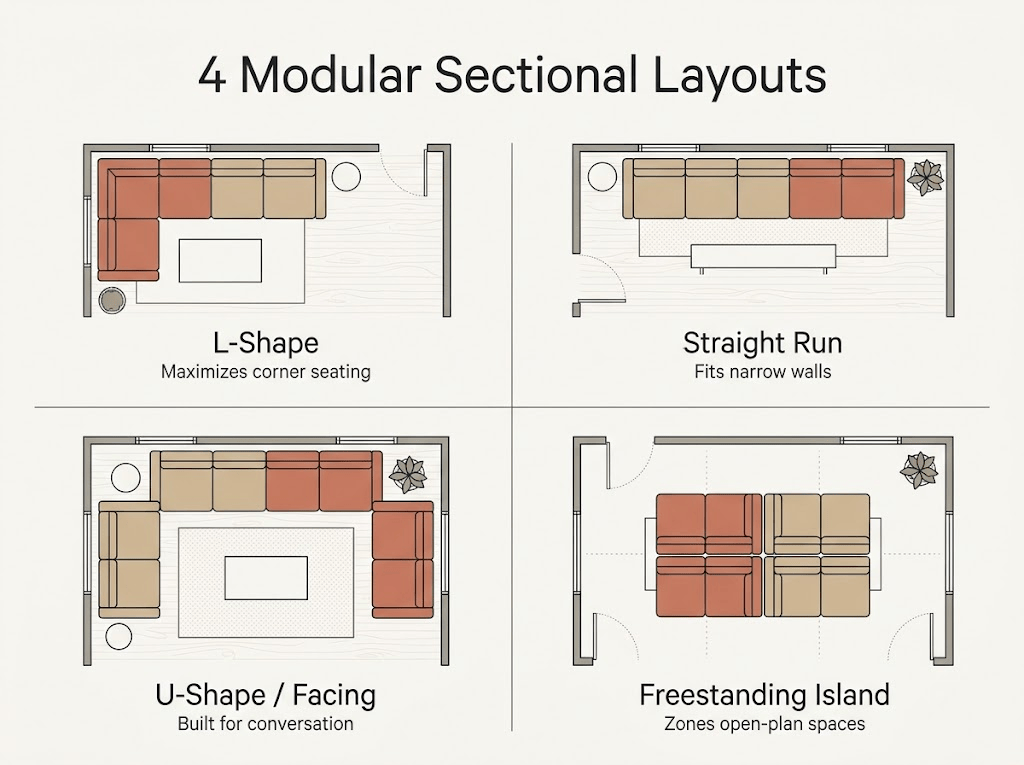
Before locking into one floor plan, it pays to map out the different layouts your modules can support down the road:
- L-Shape: Tucked against two walls, this layout maximizes seating capacity in compact rooms and works best when you have a clear corner to anchor.
- Straight Run: Lining the modules up along a single wall fits narrower rooms or spaces where the sofa has to share floor area with a media console, desk, or shelving unit.
- U-Shape or Facing: Splitting modules opposite each other works well in larger rooms and naturally encourages conversation instead of pointing everyone at the same wall.
- Freestanding Island: Pulling the sectional off the walls altogether lets the sofa act as a room divider in open-plan spaces, carving out a dedicated lounge zone without putting up partitions.
Buying a sectional with all four options in mind – and picking a cover that looks sharp in every one of them – stretches your investment far beyond a couch built for one static arrangement.
Reconfiguring Without Breaking the Room
A modular sofa only lives up to its potential if the rest of the room can move with it. A rug cut tightly to an L-shape will leave awkward bare patches when you switch to a straight run. Likewise, a massive rectangular coffee table that fits one setup can become a shin-bruising obstacle in another.
Planning the supporting pieces for mobility keeps the whole room agile:
- Go slightly bigger on the rug: A neutral rug sized generously enough to handle your widest likely layout avoids awkward edges without demanding millimeter-precise alignment.
- Choose movable surfaces: Nesting tables or a coffee table on casters let you reshape the center of the room in seconds, matching the sofa’s adaptability instead of anchoring it down.
Lighting That Follows the Layout
Overhead fixtures are the quiet enemy of a reconfigurable room. A pendant or ceiling spot centered for an L-shape can throw glare across a screen or leave people sitting in the dark once you pivot the sofa into a freestanding island.
Floor lamps and table lamps solve that problem cleanly. Because they move just as easily as the sofa modules, your task and ambient lighting can follow wherever the seating lands, rather than forcing you back into the layout your electrician assumed years ago.
The Long-Term Value of Choosing Flexibility Early
Opting for a modular sectional – and a cover designed to keep up with it – is really a bet on future-proofing your living space. When you furnish a room for the first time, you rarely know whether you will still be in the same apartment in three years, adding someone to the household, or simply itching for a fresh setup after staring at the same walls.
A sectional that can shift from an L-shape to a straight run or an open-plan island, wrapped in a fabric that looks clean in all three, is built for how life actually unfolds. Treating adaptability as seriously as comfort or style at checkout is what separates furniture that serves one moment from furniture that lasts for years.
