
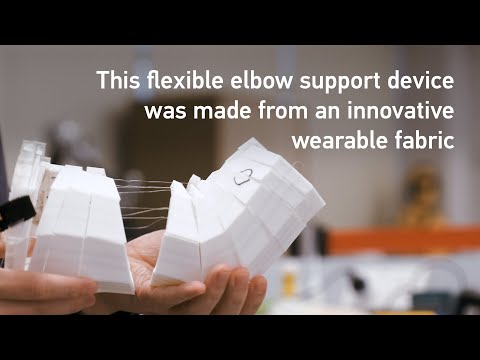
Accidents can come from the most unexpected moments, and unfortunately, those moments can lead to injuries like a fractured or broken bone. Depending on the accident’s severity, individuals are often required to wear a sling or cast. While crucial for healing, being in a cast restricts movement and can be uncomfortable. To modernize the look of the cast while still providing assistance and relief, researchers at Nanyang Technological University developed RoboFabric, a flexible wearable fabric that also stiffens when needed.
Aid healthcare and rehabilitation process
Through 3D printing and robotic technology, the RoboFabric can be customized according to an individual’s need. This reusable product is done by interlocking the 3D-printed tiles using an advanced mathematical algorithm. Metal fibers are then threaded through the spaces between the tiles and connected to an electric device that will control the cables. The softness and rigidity of the product can be controlled after.

For injured individuals, the RoboFabric can be more comfortable and easier to move about even when wearing it. Lead researcher for this project, Yifan Wang, explained that “Unlike conventional rigid and unremovable casts, they would also be easy to put on or remove at the touch of a button”.
Also interesting: Researchers Work on 3D-Printed Eyes
RoboFabric also offers wrist support for people experiencing tremors caused by diseases like Parkinson’s. In fact, according to the Parkinson’s Foundation, almost 1 million people in the US are living with Parkinson’s disease. This product can help stabilize movement so that those with the disease can do everyday tasks more efficiently.
Beyond medical aid
Aside from the medical benefits of RoboFabric, it also presents opportunities for technological advancement. Inspired by animals like the octopus, this soft robot can act as a limb for drones. Comparable to a claw machine, the fabric can help pick items up when stiffened and drop items when made loose. If successfully implemented, this can be beneficial in emergency cases when delivering food and medical supplies to stranded individuals during natural calamities.

Additionally, RoboFabric’s elbow support can be helpful when carrying and lifting heavier loads as it reduces the strength needed by 40%. It can be a useful tool in a workplace process that requires heavy lifting of materials and products. The NTU team is collaborating with industry partners to hopefully make the product available in the fields of healthcare and robotics.
YouTube: Fabulous new RoboFabric could be used in medical devices and soft robotics
By clicking play, you agree to YouTube's Terms of Service and Privacy Policy. Data may be shared with YouTube/Google.
Photo credit: The images used in the article are owned by NTU Singapore and have been provided with permission for press usage.
Source: Parkinson’s Foundation / NTU press release
