
A new study from North Carolina State University (NCSU) shows that blending artificial intelligence (AI) and computer simulation enables robotic exoskeletons to help humans with mobility. Although exoskeletons are already on the market, this research centered on equipping robotic exoskeletons with autonomous control. This way, users do not have to train them according to their needs.

Embodied AI systems
At the heart of the robotic exoskeleton research are embodied AI systems, mechanisms that consist of AI embedded into the machinery. These mechanisms enable the robot to use AI and enhance autonomous control of the exoskeleton. NCSU Associate Professor of Mechanical and Aerospace Engineering, Hao Su, shared that the research “proposes and demonstrates a new machine-learning framework that bridges the gap between simulation and reality to autonomously control wearable robots to improve mobility and health of humans.”

After extensive testing on humans, NCSU researchers observed that mundane tasks like walking consumed 24.3% less energy when using AI-powered exoskeletons compared to those walking without the exoskeleton’s support. Researchers got similar results when testing for extensive tasks like running and climbing stairs, with 13.1% and 15.4% of energy saved when the exoskeleton was used.
Improving human mobility
This study mainly revolved around the use of exoskeletons for able-bodied people. Beyond that, this discovery can be used to explore new robotic exoskeleton applications aimed at helping those with mobility impairments. Su sees that their “framework may offer a generalizable and scalable strategy for the rapid development and widespread adoption of a variety of assistive robots for both able-bodied and mobility-impaired individuals.”

Conventionally, exoskeleton users must train their exoskeleton to understand how much force is needed for specific movements. This can typically take hours. However, the AI system within the robotic exoskeleton gives users the leverage to use such exoskeletons instantly.
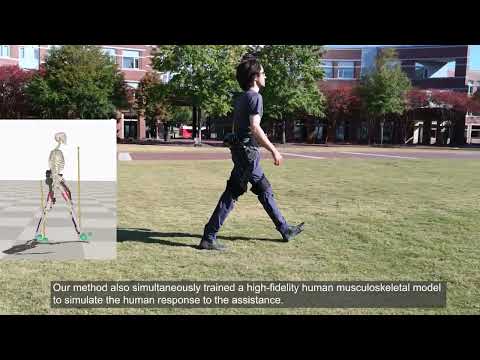
YouTube: Experiment-free Exoskeleton Assistance via Learning in Simulation
By clicking play, you agree to YouTube's Terms of Service and Privacy Policy. Data may be shared with YouTube/Google.
Photo credit: All visuals shown have been provided by the NCSU with permission to be used.
Source: Hao Su, Matt Shipman (NCSU) / Nature
