
MiniLED was once seen mainly as a premium TV technology, but as it becomes more accessible, it is increasingly becoming a practical upgrade for households moving beyond conventional LED TVs. For viewers considering their first MiniLED TV, the key question is not simply whether the technology is more advanced, but whether the improvement is easy to see and easy to live with every day. Watching TV today means moving between very different kinds of content. One moment it might be a decades-old sitcom, the next a live sports broadcast, a streaming series, or a fast-paced game. Each source brings different demands, but the quality of the experience still starts with the same thing: a display capable of producing strong contrast, accurate color, and consistent detail before any intelligent processing comes into play.
The Hisense M7SR is designed to lower the barrier to entry, making it effortless for first-time MiniLED buyers to upgrade their viewing experience. Its Hi-QLED MiniLED backlight and advanced local dimming system form the foundation of its picture quality, combining precise light control with the color performance needed for everything from dark movie scenes to brightly lit sports. From there, 4K resolution, AI-assisted processing, anti-reflection technology, and entertainment-specific features work together to make the television easier to enjoy across the different ways people actually watch.
A stronger picture foundation for your first MiniLED upgrade
At the foundation of the M7SR is Hi-QLED MiniLED, which combines precise backlight control with Hi-QLED color technology to deliver stronger contrast and a greater sense of depth. Rather than simply increasing overall brightness, the local dimming system independently controls different areas of the backlight at different brightness levels. This allows bright highlights to stand out while darker areas remain deeper and more defined, helping preserve separation between light and shadow within the same scene.
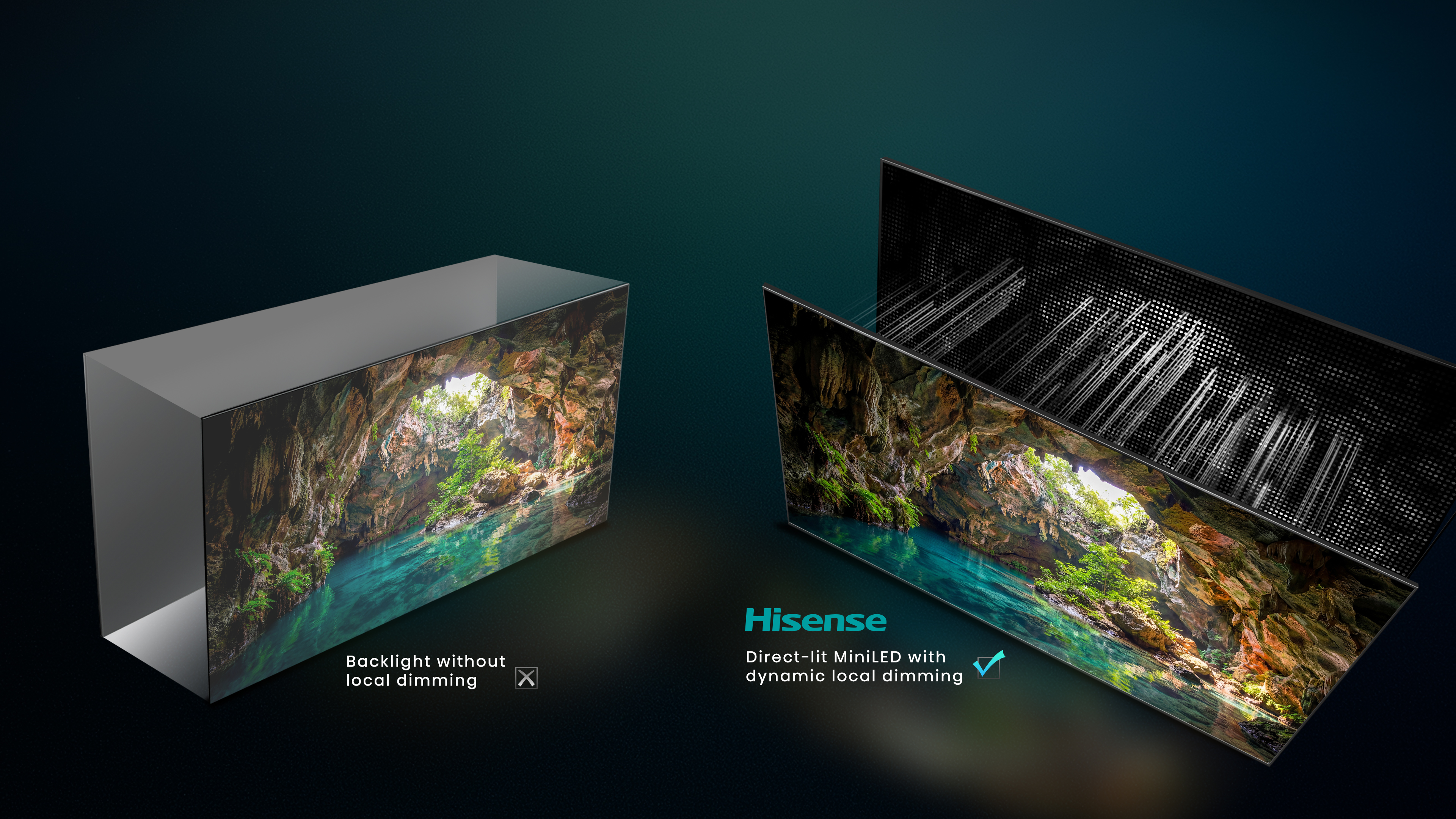
That kind of control becomes especially important in visually demanding content. A night scene can contain bright streetlights alongside dark backgrounds, while a sports broadcast might combine illuminated fields, uniforms, score graphics, and shadowed areas in a single frame. By controlling light more precisely and reducing unwanted halo effects around bright objects, the M7SR can maintain clearer transitions and more convincing contrast across a wide range of material.
The result is a picture foundation that does not depend on constant viewer intervention. Whether the content is cinematic, fast-moving, bright, or dark, the underlying display technology is already doing much of the work before additional processing is applied.
Making different content easier to enjoy
Once that picture foundation is in place, the M7SR uses 4K Ultra HD resolution and intelligent processing to help different sources look their best. Native 4K material can take advantage of the display’s full resolution. In comparison, the AI 4K Upscaler helps improve lower-resolution sources so that older shows, broadcasts, and other content can appear clearer and more detailed on the 4K screen.
AI Picture adds another layer of automation. Instead of requiring viewers to repeatedly switch picture modes or manually adjust brightness, contrast, color, and other settings as they move between different types of content, AI Picture analyzes the content. It optimizes the image for both the content and the viewing environment. That can be particularly useful in everyday viewing, where a household might move from an older TV episode to sports, streaming, and gaming without wanting to recalibrate the television each time.
The distinction is important. Hi-QLED MiniLED and local dimming establish the M7SR’s core picture performance, while 4K processing and AI Picture help make that performance more adaptable to the content being watched. The goal is not to make viewers think about the processing happening behind the screen, but to reduce how often they have to think about picture settings at all.
Standing up to real-world viewing
The M7SR also stands up to the test of real-world use rather than simply excelling under ideal viewing conditions. Most living rooms are not controlled theater environments. A television may be watched in bright daylight, under indoor lights at night, or in a room where windows and lamps create reflections across the display. Those conditions can affect perceived contrast, making darker areas of the image harder to see.

Anti-Reflection & Glare-Free technology addresses that problem directly. It is designed to minimize distracting reflections from daylight and indoor lighting, so the image remains clear under changing conditions. Darker areas are less likely to become washed out by glare, while colors and details remain easier to see even when the room itself cannot be completely darkened.
That has a practical benefit beyond picture quality. Viewers should not have to continually reposition the television, close curtains, move lamps, or rearrange the room to get a clear view of the screen. By reducing the impact of ambient light and reflections, the M7SR is better suited to the environments in which televisions are actually used every day.
Built for movies, streaming, and gaming
Different entertainment formats still benefit from features designed specifically around their needs. For movies and premium streaming content, Dolby Vision, HDR10, and HLG expand the range between darker shadows and brighter highlights, helping compatible content show more contrast, depth, and detail. Filmmaker Mode takes a different approach: rather than applying additional enhancement, it is intended to preserve the creator’s original intent by maintaining elements such as color, frame rate, and aspect ratio without unnecessary processing.
Gaming brings another set of requirements. Game Mode Plus includes Variable Refresh Rate and Auto Low Latency Mode, helping the television respond more appropriately when a compatible game system is connected. VRR helps keep motion smoother when frame rates change, while ALLM reduces unnecessary latency by automatically switching to a lower-latency mode. Together, these features allow the M7SR to move from movies and streaming to gaming without requiring the viewer to reconfigure the television each time manually.
Sound that complements the picture
Picture quality is only one part of the experience. The M7SR also includes DTS Virtual:X, which is designed to create a wider, more spacious soundstage through the television’s built-in speakers. For everyday viewing, that means movies, sports, shows, and games can feel more immersive without immediately requiring a separate audio system.
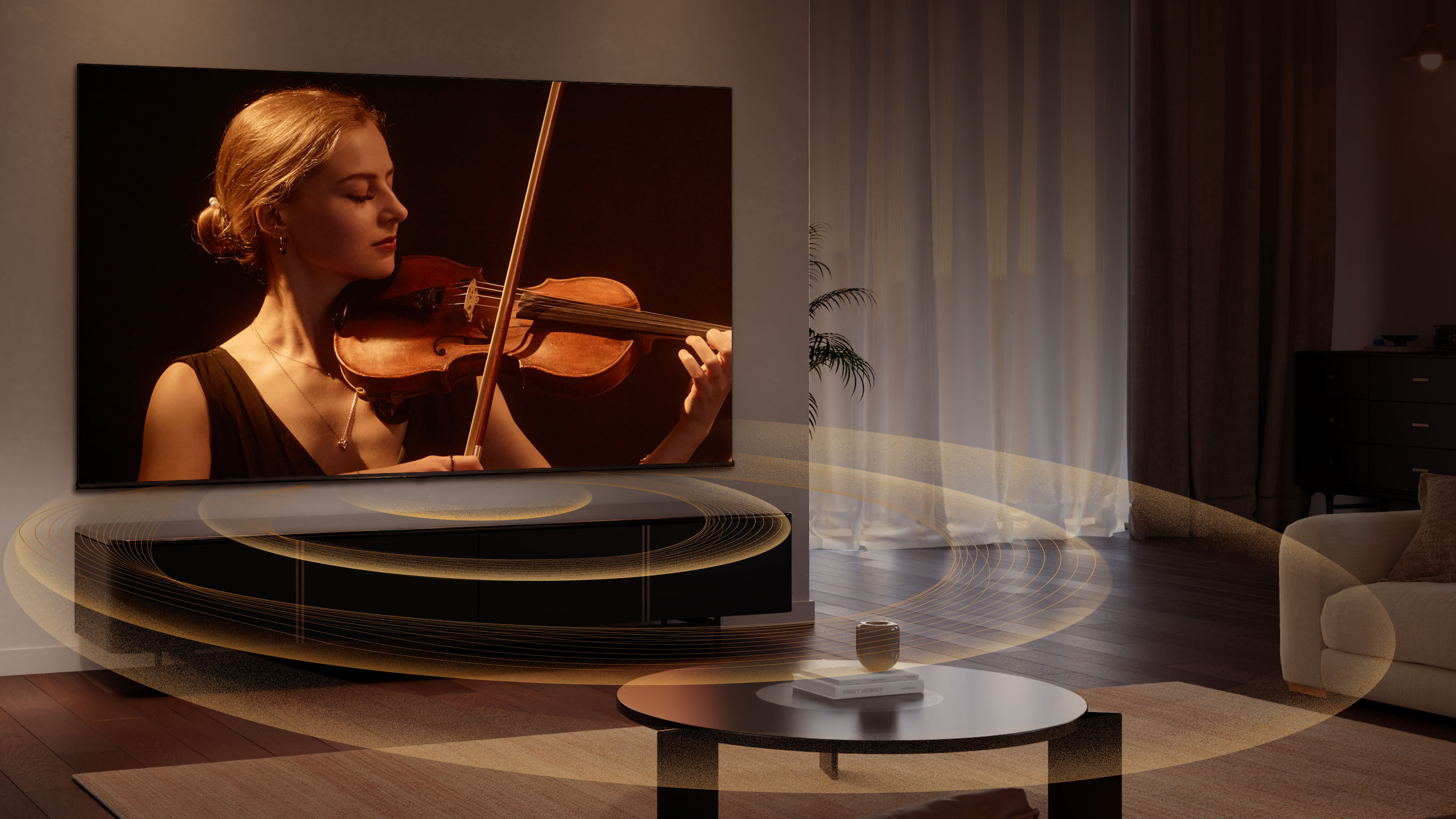
The wider sound presentation complements the television’s visual experience while keeping the overall setup relatively simple.
- A more effortless way to watch: What makes the M7SR feel more effortless is not any single specification. It is the way several features reduce the small adjustments and extra steps that normally sit between viewers and the content they want to enjoy.
- AI Picture: Modern tech addresses one of the most common frustrations by reducing the need to repeatedly adjust picture settings. Instead of manually switching modes and adjusting brightness, color, or contrast for each new type of content, the television can recognize what is being shown and automatically optimize the image.
- Roku TV simplifies another part of the experience: finding something to watch. Streaming apps, movies, shows, and live content can be browsed through a single intuitive interface, reducing the need to navigate complicated menus or separate systems to find a program.
- AirPlay 2 extends that simplicity to content already on a mobile device: Photos and videos from a compatible phone can be shared directly to the television’s larger screen, making it easier to enjoy personal content with family and friends without adding another complicated setup.
Taken together, these features address three different parts of everyday TV use: optimizing the picture, finding content, and getting personal content onto the screen. More importantly, they help position the M7SR as a compelling first MiniLED TV for the home, combining a meaningful picture-quality upgrade with an everyday viewing experience that feels approachable and easy to live with. For viewers looking to step into MiniLED without moving into a more premium or complex setup, the M7SR offers a more accessible way to make that upgrade.
Conclusion
For households considering their first step into MiniLED, the Hisense M7SR brings these technologies together as an integrated system designed to enhance the overall viewing experience. Hi-QLED MiniLED and local dimming establish the picture foundation, while 4K Ultra HD, the AI 4K Upscaler, and AI Picture work alongside them to help different sources look better without constant manual adjustment. Anti-Reflection & Glare-Free technology supports viewing in changing room conditions, while Dolby Vision, HDR10, Filmmaker Mode, and Game Mode Plus further adapt the experience to different content types.
Roku TV and AirPlay 2 extend that convenience beyond picture quality, making it easier to find content and move personal media onto the big screen. Available in sizes from 50 to 85 inches, the M7SR offers options for different living spaces and household needs. The result is a television experience built around a simple idea: The true value of advanced technology shines brightest when it becomes accessible to everyone at great value.
Bestbuy Link:
- https://www.bestbuy.com/product/hisense-75-class-m7-miniled-series-hi-qled-4k-uhd-smart-roku-tv-2026/J3Z9Z424PF/sku/6686979
- https://www.bestbuy.com/product/hisense-65-class-m7-miniled-series-hi-qled-4k-uhd-smart-roku-tv-2026/J3Z9Z424S3/sku/6686980
- https://www.bestbuy.com/product/hisense-55-class-m7-miniled-series-hi-qled-4k-uhd-smart-roku-tv-2026/J3Z9Z424S5/sku/6686978
- https://www.bestbuy.com/product/hisense-85-class-m7-miniled-series-hi-qled-4k-uhd-smart-roku-tv-2026/J3Z9Z424PH/sku/6686982
Photo credit: All images shown have been provided by Hisense.
