
The use of 3D printing initially focused on producing small plastic trinkets. As time went on, we were able to understand the technology better and create more practical items such as 3D-printed prosthetics and dental implants to integrate them into our bodies. However, should we also trust it enough to shelter us with the same type of plastic? Researchers at the University of Bristol had the same question in mind and sought to test the integrity of 3D-printed concrete during earthquakes through simulations.
Earthquake simulation
Researchers simulated the earthquakes via a high-end platform that can hold up to 50 tons. For reference, the average house weighs around 60 tons of concrete alone, more if we include other materials like sand and gypsum. However, 3D-printed houses utilizing 3D-printed concrete will naturally have different parameters, and this includes weight.

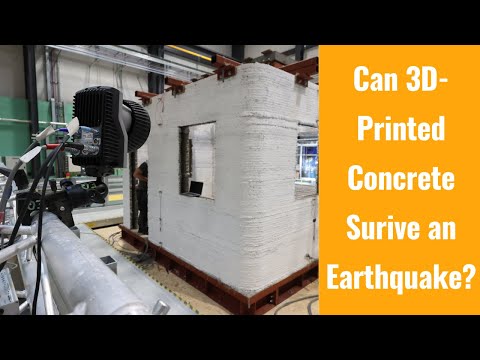
The researchers placed a quasi-real-scale unit of a structure made with 3D-printed concrete on a platform and then sent progressively stronger and more aggressive shakes to it. Multiple devices, such as accelerometers and displacement sensors, were used to record every minimal response. Results were compared to traditional construction methods. Researchers also evaluated the computational models, such as seismic predictors.

Laying the foundation for 3D-printed concrete
We already know how traditional concrete behaves during earthquakes. Even with centuries of refinement, damage is often unavoidable. As a consequence, with 3D-printed concrete, it can be even worse. We know next to nothing about how it would behave under actual seismic stress.

While similar to concrete, it introduces several variables to the concrete we all know, such as different geometries, layered disposition, and unique material properties. Of course, you don’t want any variable present if it means a risk of walls collapsing. We can 3D print houses, but we cannot gamble with lives without knowing if they will hold up.

Project leads Prof. Anastasios Sextos and Dr. Raffaele de Risi shared that the goal is to fill this knowledge gap. Simulating earthquakes on scale models made of 3D-printed concrete will help researchers understand their strengths and weaknesses, allowing for the development of safety standards and building codes in this area. With the clear speed, affordability, and sustainability advantages of 3D printing over old-school construction, this sector could become very active in the near future.
YouTube: Researchers Test 3D-Printed Concrete for Earthquake Resistance
By clicking play, you agree to YouTube's Terms of Service and Privacy Policy. Data may be shared with YouTube/Google.
Photo credit: All images shown are owned by the University of Bristol and have been made available for press usage.
Sources: University of Bristol / USGS Publications Warehouse
